The Wages of Sin:
Censorship and the Fallen Woman Film, 1929-1942
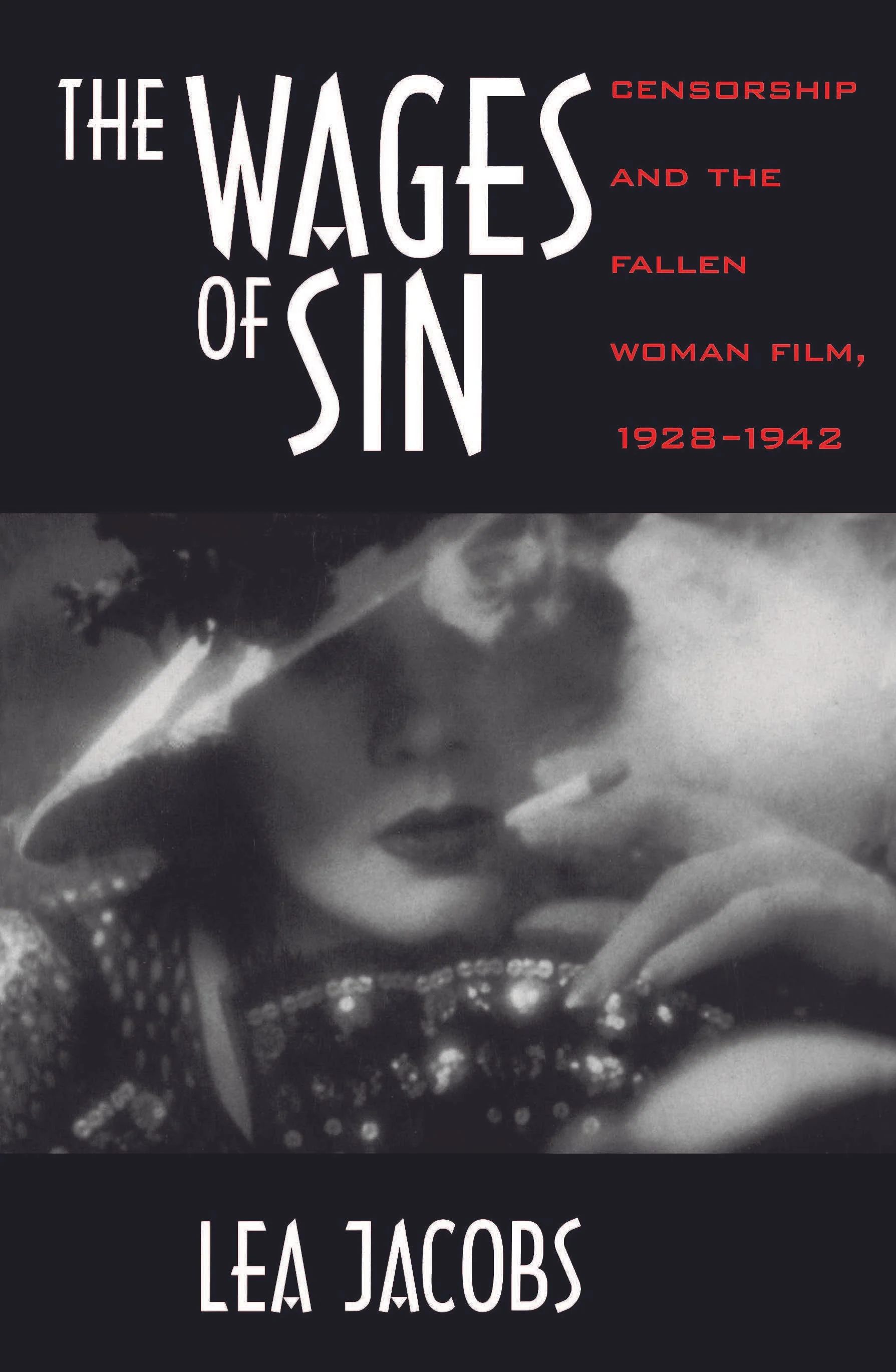
In The Wages of Sin (University of California Press, 1997) Lea Jacobs uses the fallen woman film to explore Hollywood’s system of self-censorship and the ways in which representations of sexuality were circumscribed. The story of the fallen woman was a staple of film melodrama in the late 1920s and 1930s. In traditional plots, a woman commits a sexual transgression, usually adultery. She becomes an outcast—often a prostitute—suffering humiliations that culminate in her death. In more modern variants, the heroine is a stereotypical “kept woman,” “gold digger,” or wisecracking shopgirl who uses men to become rich. This genre, often called the “sex picture” by censors, was targeted by the Motion Picture Producers and Distributors of America (MPPDA), the industry trade association responsible for censorship.
Based upon the examination of one hundred MPPDA case files, Jacobs focuses on films that posed distinct problems for the industry because they had either encountered difficulties with state censor boards or provoked protest from reform groups. Jacobs shows that, contrary to received opinion, industry censors did not cut completed films but rather negotiated with producers about potentially offensive material in story treatments and scripts. Together they treated proscribed ideas as problems of narrative and form and worked out compromises for their representation. The genre thus offers a means of analyzing in some detail how social conflicts about Hollywood’s treatment of gender roles, marriage and sexuality impinged upon narrative conventions.
Table of Contents
“This is the single finest work on the Hollywood Production Code and among the very finest examples of original historical research and feminist approaches to film history, film censorship, and American film genres in the 1930s.”
— Tom Gunning
RELATED WORK
“Rethinking the Production Code”
Lea Jacobs and Richard Maltby | ed., special issue of the Quarterly Review of Film and Video vol. 15, no. 4, (1995).
Table of Contents and Introduction
Lea’s article in the issue, “An American Tragedy: a comparison of film and literary censorship"
“Industry Self-Regulation and the Problem of Textual Determination”
Lea Jacobs | The Velvet Light Trap 23 (Spring 1989) | reprinted in Controlling Hollywood: Censorship and Regulation in the Studio Era, ed. Matthew Bernstein (Rutgers University Press, 1999).
CREATING A RESOURCE FOR RESEARCH ON HOLLYWOOD CENSORSHIP
I am glad to have had a small part in the creation of the collection cataloged as “Motion Picture Association of America Production Code Administration records” at the Margaret Herrick Library of the Academy of Motion Picture Arts and Sciences.
Read the Herrick’s description of the collection.
I began doing research with film industry censorship case files in the early 1980s before they were publicly available for research. At that time, the files were kept in the facilities of the MPA’s rating board administration (the MPPDA was eventually renamed the Motion Picture Association or MPA). The office of the rating board was located on the second floor of a Rexall drug store building adjacent to what was about to become the Beverly Center. At the time, I was a graduate student contemplating a study of the fallen woman genre. Curious about the censorship of such films in the 1930s, I was lucky to be granted an interview with Albert E. Van Schmus, who had been employed by the rating board administration for many years and was on the verge of retirement. (Find Barbara Hall’s oral history with Mr. Van Schmus.) Mr. Van Schmus was worried that the files relating to the Production Code Administration, which dated from before the rating system went into effect, would be deemed irrelevant and discarded.
Sympathetic to historical researchers, he kindly allowed me to spend a month examining the case files which pertained to my study, thus paving the way to what became my doctoral thesis and eventually my first book. He also agreed to speak with someone from the Academy of Motion Picture Arts and Sciences about the PCA files, and I put him in contact with archivist Sam Gill, who then managed special collections for the Herrick. After a period of negotiation, the files were put on deposit at the library in 1983. They eventually constituted a large collection of 240 linear feet with material on slightly less than 20,000 titles.
In addition to Mr. Gill, other Academy archivists became involved with organizing the collection and making it available to researchers. My first discussions with Barbara Hall, who became a friend, dated from the early 1990s. Barbara noted that people would often come in and request a file on a single film. She considered this a potentially misleading use of the collection because it is very difficult to figure out what the institutional context was—the issues confronting producers on one hand and industry censors on the other—from a single case. Thanks to Barbara’s leadership, the Herrick made great strides in creating finding aids and making the collection more user-friendly. A search on a film in the Herrick’s main online catalog will provide, among other things, detailed information on the holdings within the Production Code Administration collection on that title (see a sample). In addition, the Academy has released two different sets of selected files with full documentation.
On microfilm:
History of cinema. Series 1, Hollywood and the Production Code: selected files from the Motion Picture Association of America Production Code Administration collection (Woodbridge, CT: Primary Source Microfilm, 2006).
Online:
Margaret Herrick Library Digital Collections: Motion Picture Association of America. Production Code Administration Records. Full documentation of 500 selected titles.